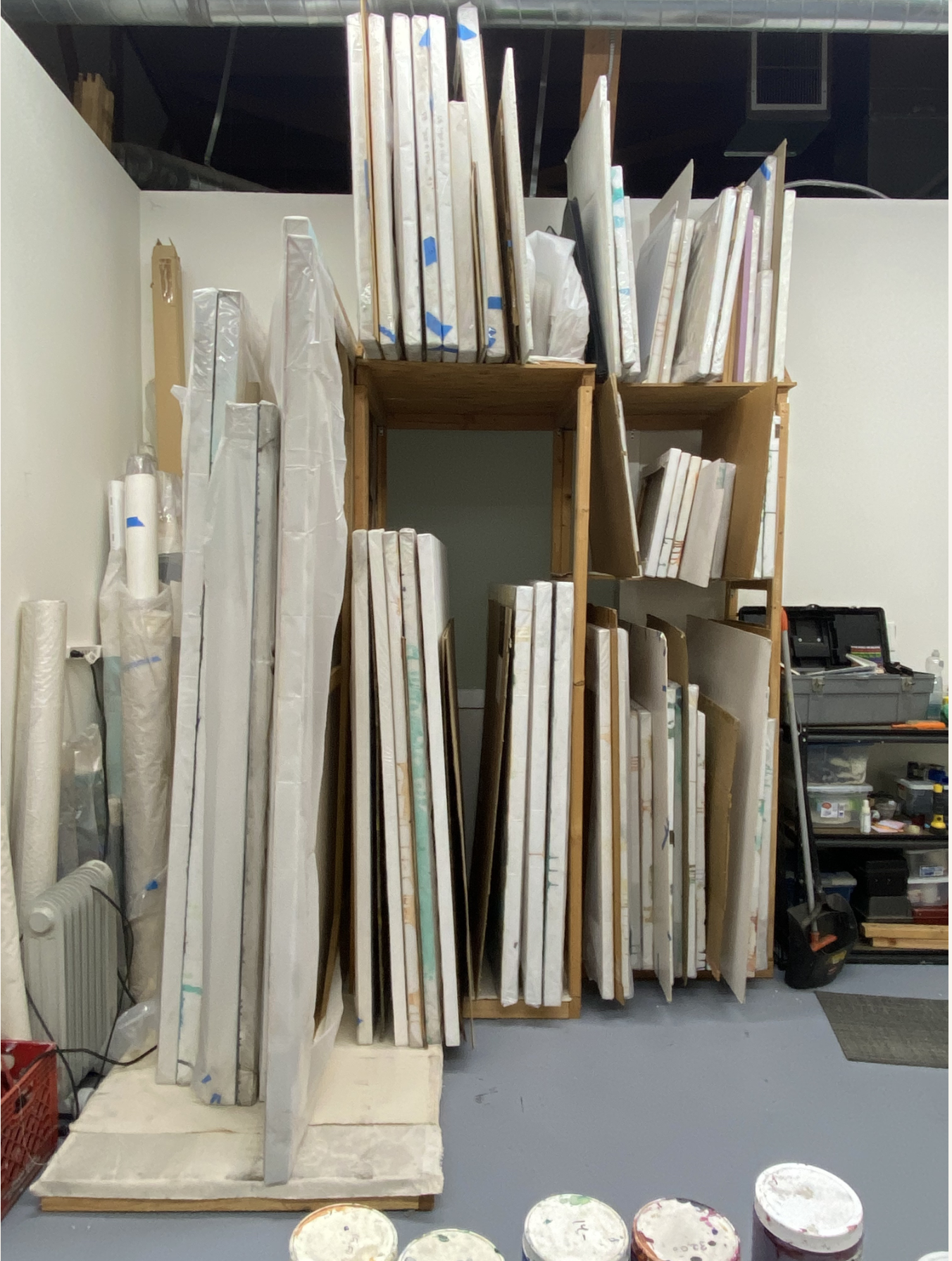
On Monday, I moved my studio. I love a fresh start. This transition has been a source of relief and excitement that I have been looking forward to since I found a new space in October. New year, new studio!
For this move, I tried to purge things that I was hoarding—materials that I think I'll use someday but won't, weird equipment that was unloaded onto me that I've been holding on to just in case...
I thought I did a fairly good job passing things along to other artists or to the garbage can, until I had a dawning realization about another stash of items that seemed to balloon as I pulled it all off my shelves.
I've been lugging this stash with me from studio to studio and it grows each passing year. As my awareness grew of this accumulation, so did my panic. How could I have let this get so out of control?
I'm talking about my paintings.
I have been out of school for over 20 years. I love to paint. One might say that I am prolific. This is evidenced by the stacks, and stacks, and more stacks of paintings. Then there are the rolls! Canvases that I have unstretched and rolled up, forming my "archive." I found portfolios of drawings and paintings on paper that I had forgotten about. All in, I have over 100 works of art in my studio.
When I pulled it all down to disassemble my storage racks, I realized just how great at tucking things away I have become. A new emotion crept up that I haven't felt before in relation to my work: embarrassment. All this work that no one wants! I am a hoarder of my own work.
While I was trying to make sense of this new feeling, I wondered why I didn't feel proud. Usually, I like to look back at the work I've made over the years. It's like looking through an old photo album, being reminded of periods of experimentation, or having breakthroughs. Risks I took, stages of my artistic growth, and seeing some really great paintings that I've made.
But this time was different. The stockpile of decades worth of paintings highlighted that I have not prioritized selling my work, even though this is, in fact, something that I actually want. I am not making paintings for myself, but for other people. The looming piles and piles of paintings were a voluminous reminder of one thing I am failing miserably at.
It's not like I haven't sold anything, but because I haven't given this aspect of my artistic life much effort, I am now paying for it with a sore back. Hindsight is coming into 20/20 focus.
I recently learned a phrase "temporal milestones" which is a fancy way to describe holidays, anniversaries, and (of course) the new year. And here we are at a big temporal milestone.
I LOVE temporal milestones. I personally create routines just so I can break them and use these time markers to pivot, refocus and make plans.
Moving studios is one of my favorite ways to shake things up and unsettle stagnate patterns. I've gotten into a cycle where my studio lease is always over on December 31, making these two transitional milestones intertwined. This ultimately forces an inventory of not just my stuff, but my routines and processes to see what is working and what is not. Mistakes I've made and let fester along with relics of success are under the spotlight.
This move and all it's associated feels have made it abundantly clear what needs my attention. Sometimes it takes uncomfortable feelings to push you to shift focus and redirect attention to where it needs to go.
If you know me, you know I love problem solving, so this has given me lots of ideas about creative ways to deal with my storage issue. Maybe you have been here before...I'd love to know what your relationship is to work that does not sell right away. Have you had studio sales? Retrospectives? Or bonfires?
So here we are in a brand new year. Reflection shows me that my baggage can be fuel for change. Negatives can become positives. And as Anne of Green Gables said, "Tomorrow is always fresh, with no mistakes in it." This year is a clean slate.
Wishing you fresh starts with no mistakes (yet),
Virginia
UPDATE:
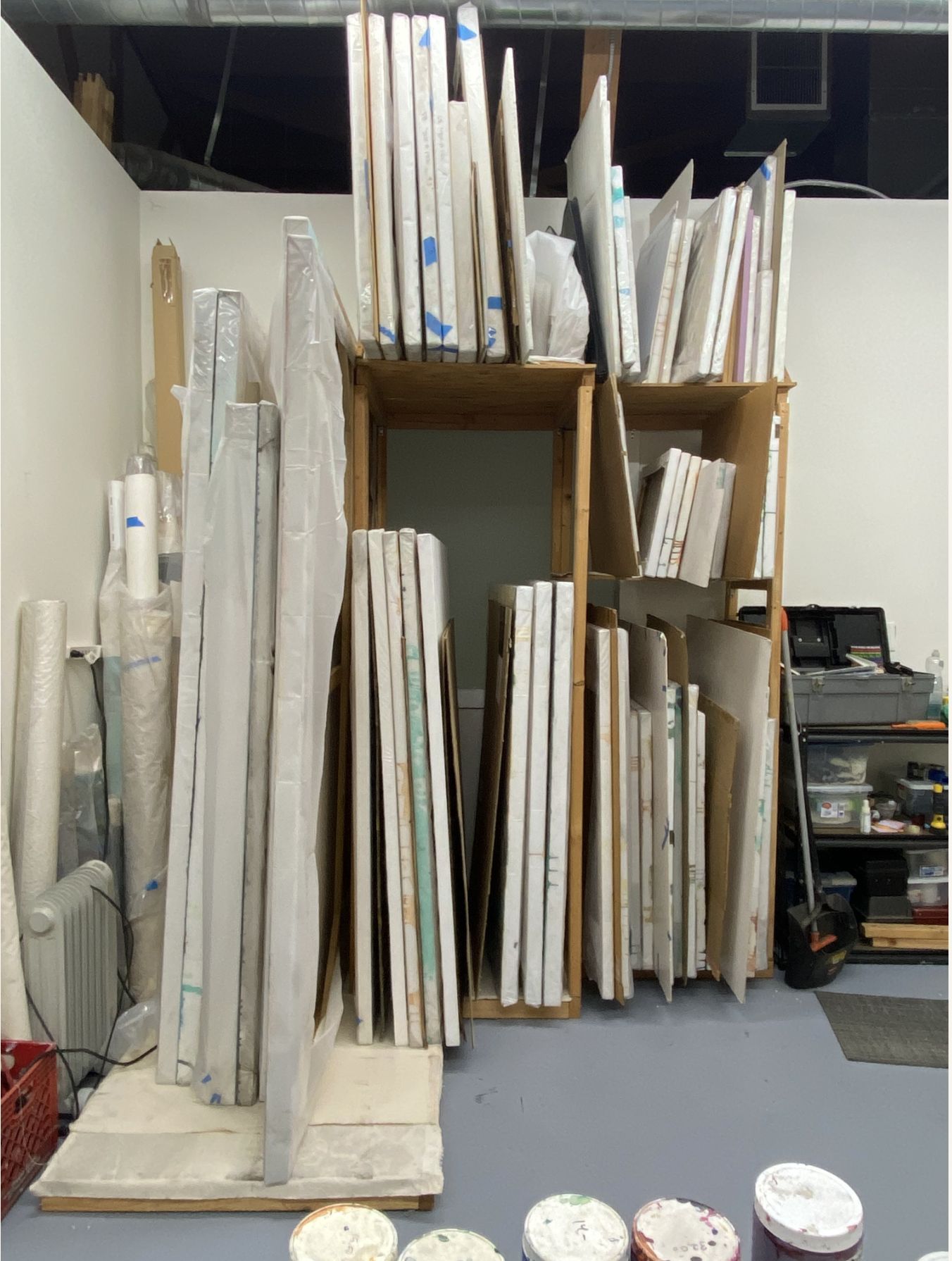
On Tuesday, I finished assembling my storage racks and tucked everything away once more. It's not so bad!
Once I came out of my emotional tunnel vision, I recalled all the ways that I’ve worked with artists through similar revelations. I’ve problem solved with sculptors to arrive at a commission focused practice. I’ve helped artists pitch survey shows to institutions.
William Powhida has also developed inventive systems for renting unsold art such as the Zero Art Fair and Store-to-Own. Artist Barbara T. Smith came up with a fun way to distribute work and regain some agency (read about it below in Off the Bookshelf). I have friends who have gotten storage units to clear their studio for new work, and I know artists who have purchased giant warehouses for storage. This problem is by no means unusual.
Off the Bookshelf:
I’m currently reading Barbara T. Smith’s memoir, The Way to Be, in preparation for a book group. She was a pioneering artist who made some extraordinary work at the forefront of the burgeoning performance art genre in the 1970s.
In the late 1960s, she had this idea for a project that she just had to make. Titled Field Piece, the work was comprised of 180 nine-foot tall cast resin “blades of grass” that lit up when a sensor picked up that there was someone nearby.
The sculptural installation took up a lot of space, was costly, and took her four years to complete. She used up most of her divorce money, proceeds from the sale of her house, and depleted her stocks. She ultimately spent $40,000 (a gut wrenching $350,000 in todays dollars) to complete the piece. Her commitment to this work was unwavering.
Once completed, it was shown at a couple galleries and then in a show curated by Judy Chicago at the Long Beach Museum of Art. Her sculpture was installed outdoors, so she needed to waterproof it. During the course of the exhibition, the work was vandalized, and the museum did not reimburse her in any way for the work.

The exhibition closed, and Smith was out of money. She had no way to store the large work which was partially damaged. She decided to try to sell off the individual blades and sent an ad to folks who might be interested. The blades were $40 each and in the end, she sold very few. She says in her memoir:
“I had made this wonderful and generous artwork and worked my tail off to do it, but in the end, no one wanted it.”
Smith came up with an inventive and playful way to distribute the remaining blades.
“With the help of friends, I secretly installed single blades at friends’ and enemies’ homes, as well as at other beautiful sites. We called this action Guerrilla Capers. As pranksters, my friends and I finally found some agency and enjoyed moments of relief.”
by Barbara T. Smith